
The Project
ROCINANTE in a nutshell
ROCINANTE (Taming nonlinear oscillations and turbulence for optimal design and operation of space plasma thrusters) is a 2 M€ ERC Consolidator Grant project to understand and control the instabilities, nonlinear oscillations, and turbulence of electrodeless plasma thrusters (EPTs), a promising new class of space propulsion technology. The project started in October 2026, and has a total duration of 5 years. The central goal is to:
Unravel and control the instabilities, nonlinear dynamics, and turbulence
that cause anomalous transport in electrodeless plasma thrusters.
Read on to find out more about the motivation, objectives, and methods of the project.
Electrodeless plasma thrusters
Electric propulsion uses electric and magnetic fields to accelerate an ionized propellant, achieving a specific impulse 10–20 times higher than chemical rockets. It already serves more than half of the satellites around the Earth. However, the established Hall thrusters and gridded ion engines rely on plasma-exposed electrodes and neutralizers, which:
- Erode over time and limit the lifetime of the device
- Complicate the electronics and drive the cost up
- Restrict the propellants to scarce noble gases like xenon and krypton
- Make it hard to scale up to the high powers that future space tugs will need
Electrodeless plasma thrusters, such as the helicon plasma thruster and the electron-cyclotron resonance thruster, heat the plasma with electromagnetic waves and accelerate it contactlessly in a magnetic nozzle. With no electrodes and no neutralizer, they can work with almost any propellant, are simpler to build and operate, and could scale up to hundreds of kilowatts.
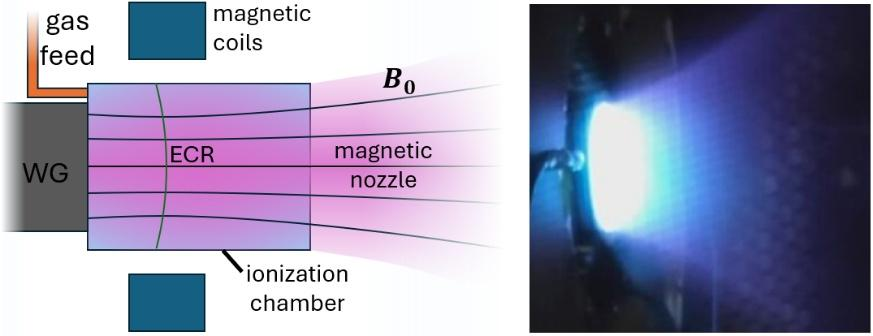
Sketch of a waveguide electron-cyclotron resonance thruster (left) and the UC3M prototype firing (right).
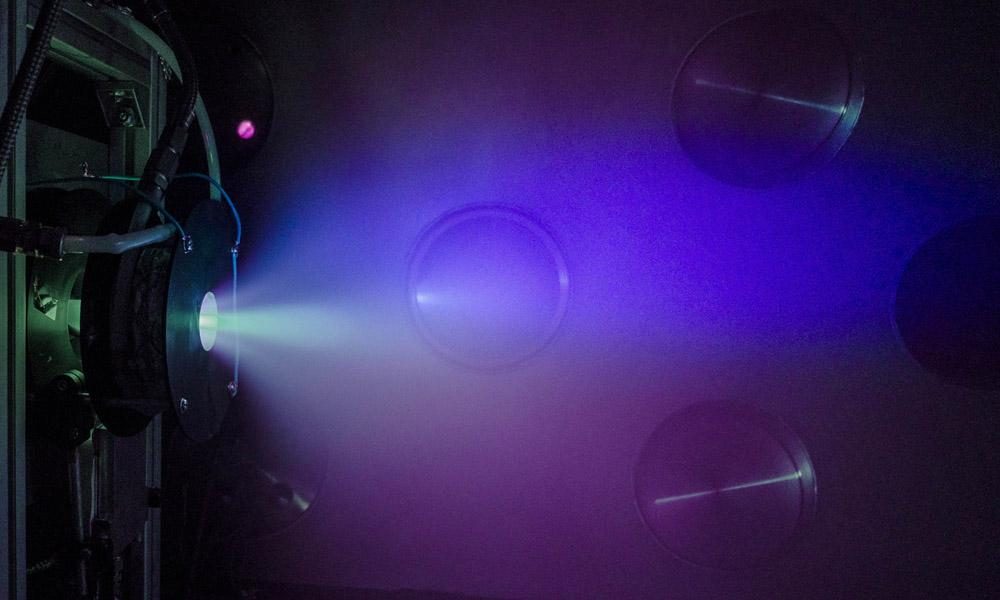
The EP2-SENER helicon plasma thruster.
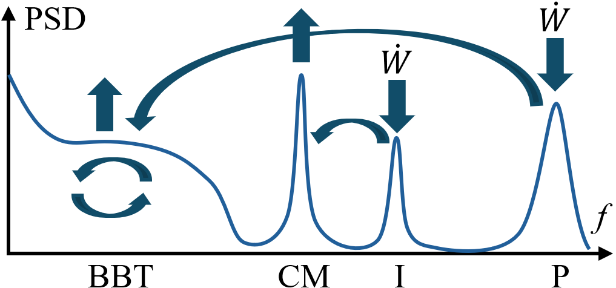
Power spectrum of the electromagnetic field in a hypothetical plasma, with power entering at the pump wave (P) and an instability (I), and nonlinear transfers to low-frequency broadband turbulence (BBT) and a coherent mode (CM) that drive anomalous transport.
The problem: anomalous transport
In spite of recent progress, with thrust efficiencies upwards from 20% in the best prototypes, electrodeless thrusters still lag behind the mature technologies. The main problem to be solved is anomalous transport: the plasma crosses the magnetic field lines much faster than classical collisions would allow. More plasma reaches the walls, eroding them and recombining there, which reduces both efficiency and durability.
Our group and others have found plasma oscillations in these thrusters, from coherent azimuthal modes to broadband turbulence, which likely drive this transport. But which instabilities are at play, how the strong applied electromagnetic fields take part, and how energy is exchanged nonlinearly among frequencies are open questions.
Four gaps stand in the way: the lack of quality experimental data from inside the thruster, the limits of current kinetic-electromagnetic models, the lack of analysis tools for the nonlinear dynamics, and the uncharted control of these oscillations.
ROCINANTE Objectives
ROCINANTE aims to unravel and control the instabilities, nonlinear dynamics, and turbulence that cause anomalous transport in electrodeless plasma thrusters.
To do so, the project focuses on four specific objectives:
Experimental datasets
Obtain high-accuracy, high-resolution measurements of the fluctuation spectrum inside and near the thruster source.
Fast kinetic simulations
Establish an unprecedentedly fast and accurate kinetic-electromagnetic plasma model.
Nonlinear physics
Elucidate the roots and nature of the nonlinear oscillations and turbulence, and their effect on anomalous transport.
Monitoring and control
Assess the observability of the oscillating structures and their controllability with simple actuators.
Research methods
ROCINANTE combines laboratory experiments, numerical simulation, and data-driven analysis in four work packages:
- Experiments: a scaled-up waveguide electron-cyclotron resonance thruster, with unparalleled access for non-intrusive diagnostics (Langmuir probe arrays, wall probes, pick-up coils, and photomultipliers), to measure the fluctuations inside the source with minimal perturbation.
- Simulation: a new fully implicit, energy-conserving particle-in-cell code with the Darwin electromagnetic model, which keeps only the few azimuthal modes that matter to run 3D kinetic simulations at least 100 times faster than today's codes.
- Nonlinear data analysis: modal decompositions (POD, DMD), bispectral analysis, and sparse system identification (SINDy) to find the dominant modes, their interactions, and reduced-order models of the dynamics.
- Monitoring and actuation: sensors embedded in the source to estimate the plasma state, and wall probes and coils used as actuators to test how the oscillations respond to periodic forcing.
Experiments will take place in the large vacuum chamber of the Plasmas and Space Propulsion Team at the Department of Aerospace Engineering at Universidad Carlos III de Madrid.
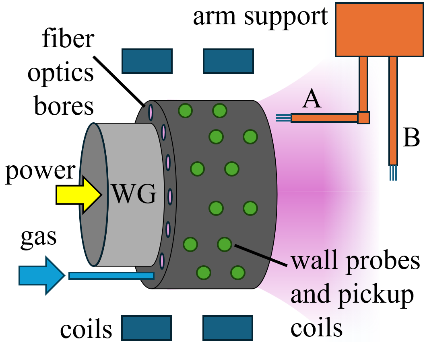
Sketch of the planned experiment: the plasma source with its waveguide (WG), magnetic coils, wall probes, pick-up coils and optical bores, and two arrays of Langmuir probes (A and B).
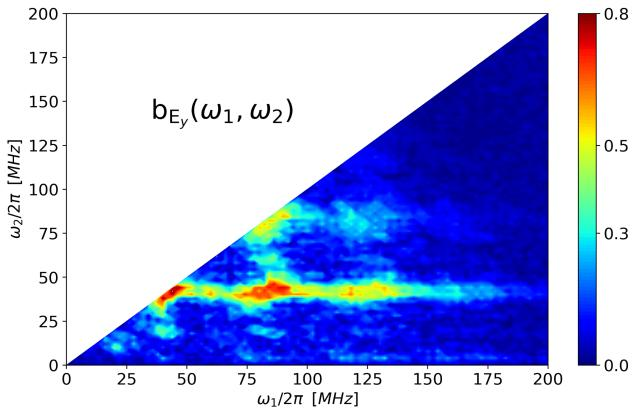
Bicoherence of the azimuthal electric field in an E×B discharge simulation: values close to 1 reveal nonlinear interactions between frequencies.
"Understanding and controlling anomalous transport will boost the efficiency and durability of electrodeless plasma thrusters, enabling them to satisfy the propulsive needs of the future"
Project impact
The success of ROCINANTE will contribute toward the theory of instabilities, nonlinear oscillations, turbulence, and anomalous transport in electrodeless plasma thrusters, and the first assessment of the observability and controllability of their oscillating structures, opening the way to actively controlled, efficient thrusters.
The ideas and methods of the project can also be extended to Hall thrusters and to other fields where instabilities and turbulence play a key role, such as nuclear fusion and plasma-based manufacturing.